
October 13, 2026
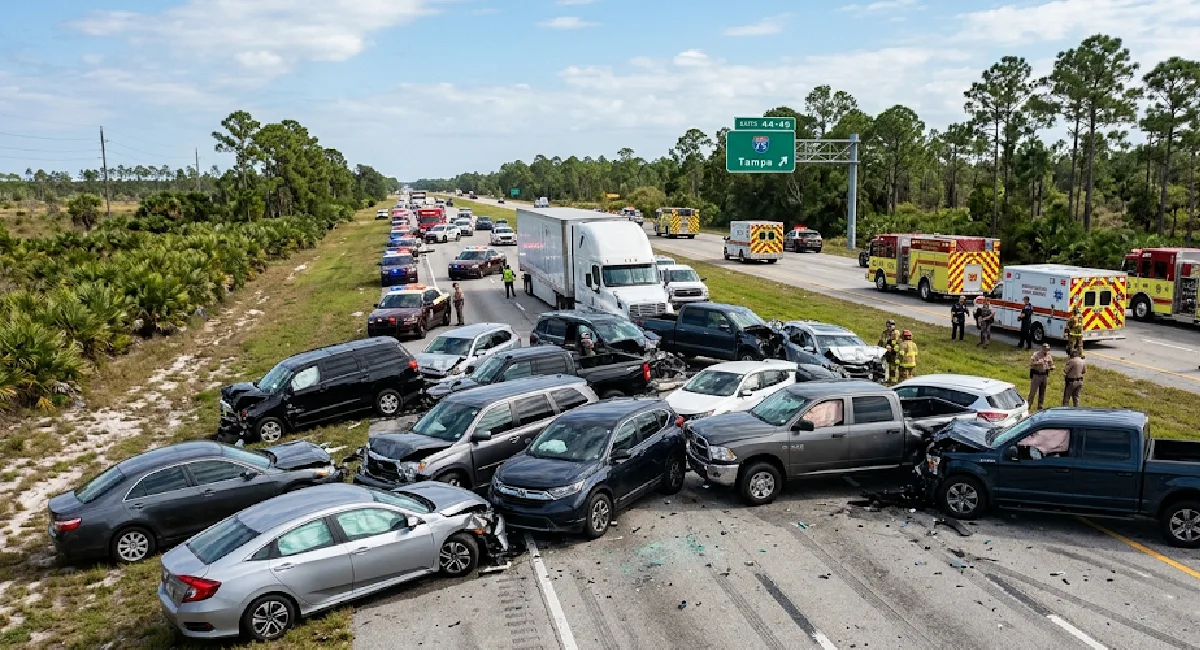
Multi-vehicle accidents are among the most legally complex crashes in Florida personal injury law. When three, four, or a dozen vehicles are involved in a chain reaction or pile-up, the questions that are straightforward in a two-vehicle crash become significantly more complicated. Who started the chain? Did intermediate drivers contribute independently? Which insurance covers which damages? Who do you sue, and in what order?
These aren’t academic questions. The answers determine how much you recover and from whom. Here’s how multi-vehicle accident liability actually gets sorted out in Florida.
How Multi-Vehicle Accidents Happen
Understanding the mechanics of a multi-vehicle crash matters because it shapes the liability analysis from the start.
Chain reaction rear-end crashes are the most common multi-vehicle scenario. Vehicle A rear-ends vehicle B, which is pushed into vehicle C, which may then be pushed into vehicle D. The initiating driver bears primary liability for starting the chain, but intermediate drivers may have contributed independently if their following distance was insufficient to stop even without the initial impact.
Fog, smoke, and low-visibility pile-ups are a specific Florida hazard. Florida’s I-75 in Alachua County and portions of I-4 in Central Florida have histories of catastrophic multi-vehicle pile-ups in fog or smoke conditions. When visibility is severely reduced, the question of whether drivers exercised appropriate caution for conditions, by slowing, pulling off, or activating hazard lights, becomes central to the liability analysis across every vehicle involved.
Interstate debris and obstacle crashes occur when a vehicle hits debris on the highway and swerves, brakes suddenly, or stops in a travel lane, triggering reactions from multiple following vehicles. Whether the driver who hit the debris, the driver who lost the cargo that created the debris, or the following drivers bear liability depends on the specific facts.
Multi-point intersection crashes involve more than two vehicles entering an intersection from different directions. These crashes combine the right-of-way complexity of standard intersection crashes with multiple defendants and multiple insurance sources.
The Core Liability Question: Who Started It
In a chain reaction crash, the driver who initiated the sequence bears the heaviest liability burden. They caused the first impact that set everything else in motion. Establishing who initiated the chain requires reconstructing the crash sequence from the physical evidence.
Vehicle crush patterns establish the direction and sequence of impacts. A vehicle with front-end and rear-end damage was struck both from behind and pushed into a vehicle ahead, placing it as an intermediate vehicle rather than the initiating one. A vehicle with only front-end damage struck something ahead without being hit from behind. A vehicle with only rear-end damage was struck without making contact with anything ahead.
EDR data from each vehicle captures speed, braking, and throttle position in the seconds before each impact. In a chain reaction crash, the data from each vehicle establishes when each driver began reacting, which helps sequence the events and identify who had time to stop and who didn’t.
Skid mark analysis establishes where each vehicle was when braking began, which feeds into the reconstruction of the crash sequence and the assessment of each driver’s following distance and reaction time.
Independent Negligence of Intermediate Drivers
This is the question that makes multi-vehicle cases complex beyond the initiating driver’s liability. An intermediate driver who was following too closely to stop even without the initial impact contributed independently to the crash and may share liability with the initiating driver for vehicles ahead in the chain that they struck.
Florida’s modified comparative fault framework applies across all defendants in a multi-vehicle case. Each defendant’s percentage of fault is determined, and liability for your damages is allocated accordingly. You can recover from each defendant in proportion to their fault, subject to Florida’s joint and several liability rules.
The practical consequence is that your attorney is evaluating not just the initiating driver’s liability but every intermediate driver’s conduct. A driver who was tailgating at highway speed in a situation where they should have maintained greater following distance, or who failed to slow appropriately for deteriorating conditions, shares liability for the harm their vehicle caused even if they themselves were struck first.
Multiple Insurance Sources
Multi-vehicle crashes involve multiple insurance policies, and navigating those policies correctly is essential to maximizing recovery.
Each at-fault driver’s liability policy is a potential source of compensation. In a five-vehicle pile-up with three drivers sharing fault, there may be three separate liability policies available. The limits of each policy apply to that driver’s share of liability.
Your own PIP coverage pays your initial medical expenses regardless of fault. Your own UM/UIM coverage becomes relevant if any of the at-fault drivers are uninsured or underinsured relative to their share of your damages.
In crashes involving commercial vehicles, the carrier’s commercial liability policy, which typically carries higher limits than personal auto policies, becomes part of the coverage picture. When the initiating driver was a commercial truck, their carrier’s policy is the primary source of recovery for the entire chain that follows.
When a government entity’s road design or maintenance contributed to the crash, sovereign immunity coverage and the notice requirements for government claims add another layer to the insurance analysis.
Florida’s Joint and Several Liability Framework
Florida modified its joint and several liability rules as part of the 2006 tort reform. Under current Florida law, joint and several liability applies only when a defendant is found more than 10% at fault. Below that threshold, each defendant is responsible only for their own proportionate share.
The practical implication in multi-vehicle cases is that when you have multiple defendants each bearing a portion of fault, recovery from any single defendant is limited to their proportionate share unless their fault exceeds 10%. Collecting the full judgment requires pursuing each defendant for their share.
This makes identifying and pursuing all liable parties critical. Leaving a significant defendant out of the case because they seemed less obviously at fault can mean leaving a meaningful portion of your damages unrecovered.
Proving Your Own Freedom From Fault
In a multi-vehicle crash, your own driving behavior is scrutinized by every defendant’s insurer simultaneously. Each insurer has a financial incentive to shift fault to you or to other defendants, reducing their client’s proportionate share of liability.
Proving that you maintained appropriate following distance, were traveling at a safe speed for conditions, and reacted as a reasonable driver would have when the chain reaction began requires the same physical evidence and reconstruction analysis that establishes the other drivers’ fault. Your EDR data, your vehicle’s crush patterns, and your pre-crash position all contribute to establishing that your conduct wasn’t a contributing cause.
Investigating Multi-Vehicle Crashes
Multi-vehicle crash investigations are more demanding than standard two-vehicle cases because the evidence picture is larger and more complex. Multiple vehicles means multiple EDR systems to preserve, multiple sets of cell phone records to subpoena if distraction is suspected, and a physical scene with more elements to document.
Law enforcement investigations of serious multi-vehicle crashes are typically more thorough than those of standard crashes, and the crash reconstruction officers who investigate major pile-ups produce detailed reports that form the foundation of the civil investigation. Obtaining the full law enforcement investigation file, including all supplemental reports, reconstruction data, and physical evidence documentation, is an early priority.
Michael McCabe’s civil engineering background and accident reconstruction expertise is directly applicable in multi-vehicle cases. The sequencing analysis, the force calculations across multiple impact events, and the following distance analysis across multiple vehicles all require genuine technical expertise. Building a coherent picture of a complex multi-vehicle crash from the physical evidence is not something that can be done without that foundation.
The Statute of Limitations in Multi-Defendant Cases
Florida’s two-year statute of limitations for personal injury claims applies to each defendant in a multi-vehicle case. Missing the deadline as to any defendant eliminates the ability to recover from them, even if the claim against other defendants is timely filed.
In a complex multi-vehicle case where the full picture of liability takes time to develop, the limitations deadline creates pressure to file before the investigation is complete. An attorney files a protective lawsuit preserving claims against all potential defendants before the deadline, then continues building the case during discovery.
Specific Challenges in Florida Pile-Up Cases
Florida’s specific driving environment creates multi-vehicle crash scenarios that recur along predictable corridors.
I-95 through Jacksonville and Duval County sees multi-vehicle crashes concentrated in heavy commuter traffic periods and during weather events. The density of commercial vehicle traffic on this corridor means many serious pile-ups involve at least one commercial truck, which changes the coverage and liability picture significantly.
I-295 in the western Duval County corridor sees pile-ups at interchange areas where merging traffic creates sudden speed differentials. The combination of high speeds and frequent merging movements produces chain reaction crashes when a single driver reacts poorly to a merge situation.
US-1 through St. Johns County, particularly in sections where rural road character meets increasing suburban traffic volume, sees multi-vehicle crashes where drivers unaccustomed to the traffic density of a corridor in transition misjudge following distances.
Rural roads in Clay and Nassau Counties with limited sight distances around curves see multi-vehicle crashes when a crash in a limited-visibility section isn’t visible to approaching drivers until they’re too close to stop.
What to Do After a Multi-Vehicle Crash
The scene of a serious pile-up is chaotic, and protecting your legal interests in the immediate aftermath requires focus on a few specific things.
Document as much as you can of the scene before vehicles are moved. In a major pile-up, law enforcement will manage scene documentation extensively, but photographs from your position showing vehicle positions, damage patterns, and road conditions add to the record.
Identify the drivers and vehicles involved in every vehicle that may have contributed to the crash. In a pile-up, it’s easy to focus on the vehicle directly ahead or behind without tracking all of the vehicles in the chain. Each driver’s information is potentially relevant to your claim.
Witness accounts in pile-up cases are particularly important because witnesses outside the crash vehicles had a view of the sequence that none of the drivers had. Get witness contact information before the scene clears.
Seek medical care the same day. Multi-vehicle crash injuries often involve the same delayed presentation that characterizes other serious crashes, and the chaos of the scene can lead victims to underestimate their injuries in the immediate aftermath.
Contact an attorney immediately. Multi-vehicle cases have more defendants, more insurance sources, more evidence to preserve, and more complexity in the liability analysis than standard crashes. The earlier an attorney is involved, the more complete the picture that can be built.
Recovering Fully From a Multi-Vehicle Crash
Multi-vehicle accident claims require an attorney who can manage multiple defendants, multiple insurance sources, and a complex liability picture simultaneously. Cases that seem straightforward because one driver clearly started the chain often have additional layers of liability that an experienced attorney identifies and pursues.
Martino & McCabe handles multi-vehicle accident cases throughout Ponte Vedra Beach, Jacksonville, St. Johns County, Duval County, and Clay County. If you’ve been hurt in a pile-up or chain reaction crash, the full picture of who’s responsible for your damages is worth developing before you settle for what any one insurer offers.
Call (904) 999-4657 or reach out at consultation@martinomccabe.com for a free consultation.
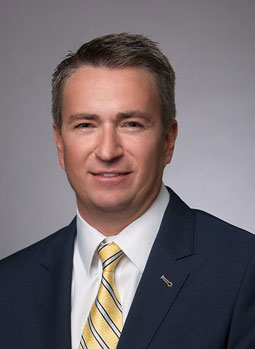
Michael J. McCabe, is a partner and owner of Martino & McCabe and practices in the areas of personally injury, auto accidents, and premises liability. He is a licensed Professional Engineer and received his Bachelor of Science in Civil Engineering from Florida State University. He earned his Juris Doctor degree from Florida Coastal School of Law in 2005 while continuing to work as a Professional Engineer.