
October 13, 2026
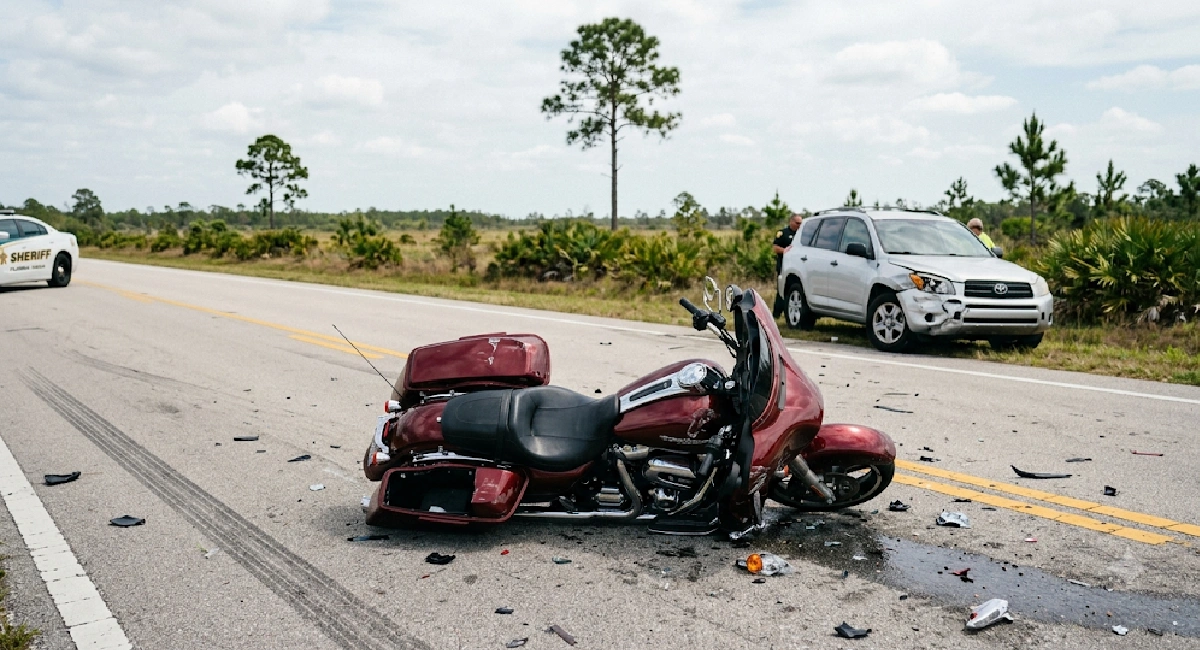
Florida is one of the top states in the country for motorcycle riding, and one of the most dangerous. The combination of year-round riding weather, heavy traffic on corridors like I-95 and US-1, a large population of drivers who aren’t accustomed to watching for motorcycles, and Florida’s unique insurance rules creates a risk environment that produces serious motorcycle accidents with regularity.
If you’ve been hurt in a motorcycle accident in Florida, the claims process has specific features that differ from standard car accident cases in ways that matter significantly to your recovery.
Why Motorcycle Accidents Are Different
A motorcycle rider has none of the structural protection that surrounds a passenger vehicle occupant. No crumple zone, no airbag, no steel cage. When a motorcycle is struck by a vehicle or goes down, the rider absorbs forces directly. The injury profile reflects that reality: road rash, fractures, traumatic brain injuries, spinal damage, and fatalities occur at rates that far exceed those in vehicle-to-vehicle crashes at comparable speeds.
This injury severity is the first thing that sets motorcycle accident cases apart. The damages are larger, the medical treatment is more extensive, and the long-term consequences are more significant than in most car accident cases. That translates into higher stakes on both sides: more to recover for the injured rider, more reason for the insurer to fight the claim.
The second difference is the bias problem. Juries and adjusters bring assumptions about motorcycle riders to these cases that don’t apply to drivers of passenger vehicles. The perception that riders are risk-takers who assume the dangers of the road affects how these cases are valued and defended. An attorney who handles motorcycle cases knows how to address that bias directly and present the case in terms that overcome it.
Florida’s Motorcycle Helmet Law
Florida requires helmet use for riders under 21. Riders 21 and older may ride without a helmet if they carry at least $10,000 in medical benefits coverage.
The helmet issue has direct legal consequences in accident cases involving head injuries. A rider who wasn’t wearing a helmet and sustained a traumatic brain injury faces a comparative fault argument that their failure to wear a helmet contributed to the severity of the head injury, even though it didn’t cause the accident itself.
Florida courts have addressed the helmet defense, and its application depends on whether the specific injury sustained would have been prevented or reduced by helmet use. A rider who broke their leg in a crash has no helmet defense to answer. A rider who sustained a TBI while riding helmetless faces a more complex argument.
Countering the helmet defense requires medical expert testimony establishing the relationship between the specific injury and helmet use, and in appropriate cases, biomechanical expert testimony about whether a helmet would have made a material difference given the forces involved in the specific crash. These arguments require preparation, and they’re one of the reasons experienced motorcycle accident representation matters.
Florida’s No-Fault System and Motorcycles
Florida’s no-fault PIP system does not apply to motorcycles. Motorcycles are specifically excluded from Florida’s mandatory PIP coverage requirement.
This exclusion has significant practical consequences. After a car accident, a vehicle occupant’s own PIP coverage pays the first $10,000 in medical expenses regardless of fault. A motorcycle rider has no equivalent first-party coverage unless they’ve purchased medical payments coverage as an optional addition to their motorcycle policy.
If the at-fault driver was operating a motor vehicle, the rider can access PIP benefits from the at-fault driver’s policy in some circumstances. But the primary coverage landscape for motorcycle riders after a crash is more limited than for passenger vehicle occupants, which makes the liability claim against the at-fault driver more immediately important.
Uninsured Motorist Coverage for Motorcycle Riders
Florida’s uninsured motorist coverage requirements don’t automatically apply to motorcycle policies. UM/UIM coverage on a motorcycle policy is optional, not mandatory.
Given that roughly one in four Florida drivers carries no liability insurance, this gap creates real exposure for riders. A serious crash caused by an uninsured driver, with no UM coverage on the motorcycle policy, leaves the rider with limited recovery options beyond pursuing the uninsured driver personally.
Riders who own both a motorcycle and a passenger vehicle need to understand whether their UM coverage on the auto policy extends to them while riding the motorcycle. Policy terms vary, and some auto policies extend UM coverage to the named insured regardless of what vehicle they’re on. Others don’t. An attorney reviews the full coverage picture across all policies early in a motorcycle accident case.
Common Causes of Motorcycle Accidents in Florida
Motorcycle accident cases have specific liability patterns that recur across Northeast Florida.
Failure to yield at intersections is the single most common cause of serious motorcycle crashes. A driver making a left turn who fails to see or misjudges the speed of an oncoming motorcycle produces a head-on or near-head-on collision at intersection speed. The rider has almost no protection. The injuries are frequently catastrophic.
The “I didn’t see the motorcycle” defense is one of the most commonly raised arguments in these cases. It’s not a valid legal defense. Drivers have a duty to look for all vehicles on the road, including motorcycles. Failure to see a motorcycle that was visible doesn’t excuse the failure to yield.
Lane changes without checking blind spots are a leading cause of sideswipe and forced-off-road crashes. Motorcycles occupy less visual space in mirrors than passenger vehicles, and drivers who don’t physically check their blind spots before changing lanes frequently strike riders who were in the lane the driver moved into.
Dooring occurs when a parked driver or passenger opens a car door into the path of a passing motorcycle. Dooring crashes in urban areas of Jacksonville and along commercial corridors in the beaches communities produce serious injuries because the rider typically has no time to react.
Road hazards produce a specific category of motorcycle accident with distinct liability considerations. Gravel, sand, potholes, oil slicks, uneven pavement, and debris in the roadway can cause a motorcycle to lose traction or control in ways that would be manageable in a four-wheeled vehicle. When a road hazard causes a crash, the entity responsible for road maintenance may be liable.
Following too closely by passenger vehicle drivers produces rear-end crashes that are particularly dangerous for motorcycles because the motorcycle provides no crush zone protection for the rider.
Proving Fault in Motorcycle Accident Cases
The liability framework in motorcycle accident cases is the same as in other car accident cases, with the added complexity of the bias issues described above. Establishing that the other driver failed to yield, failed to check their blind spot, or otherwise breached their duty of care requires the same physical evidence, witness accounts, and electronic data that support any serious crash claim.
Dashcam footage from the motorcycle is increasingly common and can be decisive. Footage that shows the at-fault vehicle failing to yield or making a lane change without signaling removes the “I didn’t see the motorcycle” defense from the equation.
Witness accounts from drivers and pedestrians who observed the crash or the events leading up to it establish the other driver’s conduct. In intersection crashes where the driver turned left in front of an oncoming motorcycle, witnesses positioned to see both vehicles’ approach are particularly important.
The at-fault driver’s deposition is often the most revealing evidence. Under oath, drivers who claimed they didn’t see the motorcycle have to explain exactly what they were looking at, when they looked, and what their visibility conditions were. Inconsistencies between their deposition testimony and what the physical evidence shows go directly to credibility.
Michael McCabe’s engineering background is relevant in motorcycle accident cases that involve technical questions about sight lines, vehicle speeds, and stopping distances. Whether the motorcycle was visible to the at-fault driver given the approach geometry, whether the driver had time to stop or yield given their speed and the motorcycle’s speed, and how the physical evidence is consistent or inconsistent with each driver’s account are all questions that benefit from engineering analysis.
Road Hazard Claims
When a road hazard caused or contributed to a motorcycle crash, the government entity responsible for the road’s maintenance may be liable. Florida law requires road authorities to maintain roads in a reasonably safe condition.
Potholes that have been reported and not repaired, sand or gravel accumulations at intersections that are a known hazard, uneven pavement transitions between road surfaces, and inadequate drainage that causes standing water are all conditions we’ve seen contribute to serious motorcycle crashes.
Claims against government entities in Florida require filing a pre-suit notice of claim within three years of the incident. Missing this deadline eliminates the government liability claim even if the overall statute of limitations hasn’t expired. Prior reports of the same hazard, maintenance records showing the defect was known, and inspection records showing the area wasn’t being monitored all feed into the liability analysis against the road authority.
The Damages Picture
Motorcycle accident damages reflect the severity of rider injuries. Medical expenses in serious motorcycle crash cases include emergency trauma care, orthopedic surgery, neurological treatment for TBI, skin grafting and wound care for road rash, and extended rehabilitation. Future medical costs for permanent injuries extend for decades.
Lost wages and earning capacity are significant when injuries prevent return to work, or limit the type of work the rider can perform. Riders in physically demanding occupations face particular challenges when orthopedic injuries impose permanent limitations.
Non-economic damages, pain and suffering, permanent disfigurement from road rash scarring and surgical scarring, and loss of enjoyment of life for riders who can no longer ride or pursue other physical activities they valued, are legitimate and recoverable losses. Presenting these damages effectively requires telling the rider’s story in a way that resonates with a jury that may start with assumptions about rider risk-taking.
Nicholas Martino’s trial advocacy training is specifically relevant in motorcycle cases that go to trial. The jury instruction on comparative fault, the presentation of the helmet defense rebuttal, and the effective communication of the rider’s non-economic losses all require trial skills that are developed through specific training and courtroom experience.
What Riders Should Do After an Accident
Call 911 and stay at the scene. If you’re physically able, photograph everything: the vehicles, the road, the damage to your motorcycle, and your injuries. Gear that was damaged in the crash, helmets, jackets, gloves, should be preserved as evidence of the impact.
Get the at-fault driver’s information. In intersection crashes and lane change crashes, witnesses who can confirm the other driver’s conduct are particularly important.
Seek emergency medical care. Motorcycle crash injuries include internal trauma and neurological effects that aren’t immediately obvious. Same-day evaluation is essential for both your health and your claim.
Don’t give a recorded statement to the at-fault driver’s insurer. Contact an attorney before any substantive conversations with any insurance representative.
Preserve your motorcycle. Don’t allow it to be repaired or scrapped before it’s been photographed and examined by an expert. The damage to the motorcycle is physical evidence of the impact force and direction.
Get Representation That Understands These Cases
Motorcycle accident cases require handling that accounts for the specific legal issues, the bias challenges, and the technical complexity that distinguishes them from standard car accident claims.
Martino & McCabe handles motorcycle accident cases throughout Ponte Vedra Beach, Jacksonville, St. Johns County, Duval County, and Clay County. If you’ve been hurt in a motorcycle crash, the full scope of what you’re entitled to recover is worth understanding before the insurer frames the case on their terms.
Call (904) 999-4657 or reach out at consultation@martinomccabe.com for a free consultation.
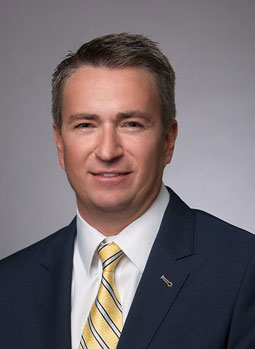
Michael J. McCabe, is a partner and owner of Martino & McCabe and practices in the areas of personally injury, auto accidents, and premises liability. He is a licensed Professional Engineer and received his Bachelor of Science in Civil Engineering from Florida State University. He earned his Juris Doctor degree from Florida Coastal School of Law in 2005 while continuing to work as a Professional Engineer.