
October 13, 2026
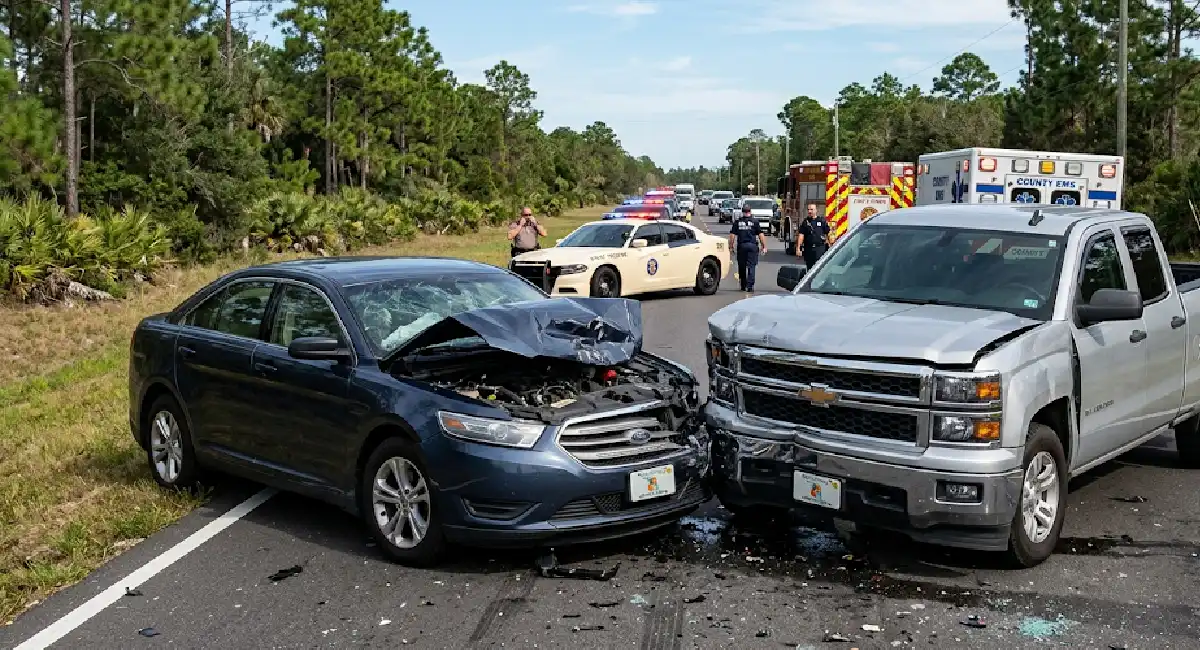
Head-on collisions account for a disproportionate share of fatal and catastrophic injury crashes despite being one of the less common crash types by volume. When two vehicles traveling in opposite directions collide, the forces involved are the sum of both vehicles’ speeds. A crash between two vehicles each traveling at 50 miles per hour produces impact forces equivalent to hitting a stationary wall at 100 miles per hour. The human body was not designed to survive that.
If you or a family member survived a head-on collision in Florida, the injuries are likely serious and the damages picture is among the most significant in personal injury law. Here’s what the claims process looks like for these cases.
Why Head-On Collisions Are Categorically Different
Every other major crash type involves a partial energy transfer. A rear-end collision involves the striking vehicle’s momentum minus whatever the struck vehicle absorbs. A T-bone involves forces primarily from one direction. A sideswipe involves glancing contact.
A head-on collision involves combined closing speeds that produce forces no passenger vehicle is designed to fully manage. Modern vehicle safety systems, crumple zones, airbags, and structural reinforcement, provide meaningful protection and have reduced fatality rates substantially, but they operate within limits that high-speed head-on crashes frequently exceed.
The injury profile in head-on crashes reflects this physics. Traumatic brain injuries, spinal cord damage with permanent neurological effects, multiple organ trauma, massive orthopedic injuries requiring extensive surgical intervention, and fatalities are all common outcomes. Recovery, when it occurs, is measured in months to years. Permanent disability is frequent.
This injury severity translates directly into damages that are among the largest in personal injury litigation: extensive past and future medical expenses, substantial lost earning capacity over potentially decades of working life, and significant non-economic losses from permanent disability, disfigurement, and the permanent alteration of the victim’s life.
Common Causes of Head-On Collisions in Florida
Head-on crashes don’t happen randomly. They have consistent causes that determine both how liability is established and what additional defendants may be involved.
Wrong-way driving. A driver who enters a divided highway in the wrong direction, whether through confusion at an interchange, impairment, or deliberate conduct, is the paradigmatic head-on collision scenario. Wrong-way driving crashes on I-95, I-295, and I-10 in the Jacksonville area occur with troubling regularity, often in the early morning hours when impaired drivers are disproportionately represented. Alcohol and drug impairment are the leading causes of wrong-way driving, which means these cases frequently support punitive damages alongside the standard compensatory recovery.
Crossing the centerline. On undivided two-lane roads throughout rural St. Johns, Clay, and Nassau Counties, crossing the centerline into oncoming traffic is the most common head-on mechanism. Causes include distraction, drowsy driving, impairment, overcorrection from running off the road, and medical emergencies. The cause matters because it determines what evidence needs to be developed and whether additional liability theories apply.
Improper passing. Attempting to pass another vehicle without sufficient sight distance or time to complete the maneuver safely is a specific form of head-on crash that occurs on two-lane roads throughout Florida’s rural corridors.
Medical emergencies. A driver who suffers a sudden and unforeseeable medical event, such as a seizure or cardiac arrest, and crosses into oncoming traffic presents a different liability picture than a distracted or impaired driver. Whether the medical event was truly unforeseeable, or whether the driver had a known condition that should have prevented them from driving, is a critical factual question in these cases.
Suicide and intentional conduct. A small percentage of head-on crashes involve intentional conduct. These cases raise the same intentional act insurance coverage issues discussed in road rage cases, and may involve criminal proceedings alongside the civil claim.
Establishing Liability
Liability in a head-on collision case usually involves a clear violation: the at-fault driver was on the wrong side of the road. That violation establishes the breach of duty element of negligence without extensive additional analysis.
The more complex questions are why the driver crossed into oncoming traffic and whether any additional parties share liability.
Impairment. Blood alcohol and drug test results from the at-fault driver, obtained through the criminal investigation if charges are filed, establish impairment as the cause of the wrong-way driving or centerline crossing. A driver who was double the legal limit and drove the wrong way onto an interstate has engaged in conduct that supports punitive damages in addition to compensatory recovery.
Distraction. Cell phone records, dashcam footage, and witness accounts establish distraction as the cause when impairment isn’t the issue. A driver who was texting when they drifted across the centerline and struck an oncoming vehicle has created both a strong liability case and potential punitive damages exposure depending on the egregious nature of the conduct.
Drowsy driving. Fatigued driving is harder to prove than impairment or distraction because there’s no chemical test for fatigue. Hours of service records for commercial drivers, evidence about the driver’s schedule and sleep in the days before the crash, and witness accounts of erratic driving before the crash all contribute to establishing fatigue.
Vehicle defects. In cases where a mechanical failure caused the driver to lose control and cross into oncoming traffic, the vehicle manufacturer or maintenance provider may share liability alongside the driver.
Road design. Inadequate centerline markings, missing guardrails on curves where oncoming traffic is a known hazard, and road design features that contribute to wrong-way entries all implicate government entities in the liability analysis.
Wrong-Way Crashes and Highway Design Liability
Wrong-way driving crashes on Florida’s interstates have attracted significant attention from FDOT because of their frequency and severity. Studies of Florida’s wrong-way crash data have identified specific interchange configurations and ramp designs that are associated with elevated wrong-way entry rates.
When a wrong-way crash occurs at an interchange that has known design issues, or where prior wrong-way entries should have prompted corrective action, a claim against FDOT or the relevant government entity may be viable alongside the claim against the wrong-way driver.
Government liability claims in Florida require a pre-suit notice filed within three years of the incident and are subject to sovereign immunity damage caps. An attorney evaluates whether the road design element is viable based on the specific facts of the crash, prior incident data at that location, and what FDOT knew about the risk.
The Damages Picture in Head-On Collision Cases
Head-on collision damages are among the largest in Florida personal injury law because the injuries are among the most severe.
Medical expenses in serious head-on collision cases often begin with extended ICU stays and multiple surgeries. Spinal cord injury rehabilitation, traumatic brain injury treatment, orthopedic reconstruction, and the ongoing care needs of permanently disabled survivors produce past and future medical expenses that can run into the millions in catastrophic cases.
Lost earning capacity for victims who are permanently disabled involves projecting what the victim would have earned over their remaining working life, which in the case of a young adult with decades of productive employment ahead can be a substantial figure. Vocational experts and economic analysts establish these projections through testimony.
Non-economic damages, pain and suffering, loss of enjoyment of life, and permanent disfigurement, are particularly significant in head-on collision cases because the injuries frequently produce permanent, life-altering conditions. A survivor who will spend the rest of their life with a spinal cord injury has suffered non-economic losses that a jury takes seriously.
Wrongful death damages apply when the crash produces a fatality, with the full framework of survivor losses under Florida’s Wrongful Death Act available to eligible family members.
Punitive Damages in Head-On Collision Cases
Impaired driving, wrong-way driving, and other egregious conduct that causes a head-on collision frequently supports a punitive damages claim. A driver who was two or three times the legal limit and drove onto an interstate in the wrong direction has demonstrated exactly the kind of conscious disregard for the safety of others that Florida’s punitive damages standard requires.
In these cases, the punitive award adds a substantial component to the total damages and changes the settlement dynamic significantly. An insurer facing both compensatory and punitive exposure on a catastrophic injury case has strong incentive to resolve the matter at a number that reflects the full scope of liability.
Insurance Coverage in Catastrophic Cases
Head-on collision cases with catastrophic injuries frequently exhaust the at-fault driver’s liability policy limits. Florida’s minimum liability coverage of $10,000 is obviously insufficient for a case involving spinal cord injury or TBI. Even drivers carrying $100,000 or $300,000 in liability coverage may be underinsured relative to the actual damages in a catastrophic case.
When the at-fault driver’s liability coverage is exhausted, the injured victim’s own UM/UIM coverage becomes the next line of recovery. Carrying robust UM/UIM coverage is more important in Florida’s accident environment than most drivers realize, and head-on collision cases with catastrophic injuries make that point emphatically.
In cases where the at-fault driver’s conduct supports punitive damages, the defendant may be personally liable for amounts above their policy limits. Whether personal assets are available to satisfy a judgment above policy limits is part of the recovery strategy an attorney evaluates.
What Survivors and Families Should Do
The immediate aftermath of a catastrophic crash is often managed by emergency responders, and the legal process may not feel urgent when someone is fighting for their life in an ICU. But the evidence that proves what happened and why starts degrading immediately.
An attorney who gets involved early can send preservation letters for surveillance footage and EDR data, investigate the crash scene before it changes, identify and interview witnesses while their memories are fresh, and secure the at-fault vehicle before it’s repaired or destroyed.
For families dealing with a wrongful death, the legal process is the last thing on the mind in the days immediately following the loss. But the two-year statute of limitations begins running from the date of death, and the evidence preservation window doesn’t pause for grief. An attorney can begin the preservation work and investigation quietly, without requiring the family to make immediate decisions about the claim.
Nicholas Martino and Michael McCabe have handled catastrophic injury and wrongful death cases arising from head-on collisions throughout Ponte Vedra Beach, Jacksonville, St. Johns County, Duval County, and Clay County. These are among the most serious cases we handle, and they receive the full depth of our technical and legal capabilities.
Call (904) 999-4657 or reach out at consultation@martinomccabe.com for a free consultation.

Michael J. McCabe, is a partner and owner of Martino & McCabe and practices in the areas of personally injury, auto accidents, and premises liability. He is a licensed Professional Engineer and received his Bachelor of Science in Civil Engineering from Florida State University. He earned his Juris Doctor degree from Florida Coastal School of Law in 2005 while continuing to work as a Professional Engineer.