
October 13, 2026
Florida is consistently ranked among the most dangerous states in the country for pedestrians. The combination of high traffic volume, wide arterial roads designed around vehicles rather than people, year-round outdoor activity, and a large elderly population produces pedestrian fatality and injury rates that consistently exceed the national average. If you’ve been hit by a vehicle while walking in Florida, the injuries are often serious and the claims process has specific features that differ from standard car accident cases.
Here’s what you need to know.
Why Pedestrian Accidents Are Particularly Severe
A pedestrian struck by a vehicle has no protection. No seatbelt, no airbag, no crumple zone. The physics are unforgiving. Even a relatively low-speed impact produces injuries that would be minor in a vehicle-to-vehicle collision.
Traumatic brain injuries, spinal cord damage, multiple fractures, internal organ damage, and severe lacerations are common outcomes of pedestrian accidents. Fatalities occur at rates that far exceed other types of crashes. At 30 miles per hour, the fatality risk for a struck pedestrian is roughly 40%. At 40 miles per hour, it exceeds 80%.
This injury profile translates directly into larger damages, longer recoveries, and more complex medical and legal cases than most car accident claims.
Florida’s No-Fault System and Pedestrians
Florida’s no-fault system, which requires drivers to carry Personal Injury Protection covering their own medical expenses, applies differently to pedestrians than to vehicle occupants.
If you were a pedestrian hit by a vehicle, you may be entitled to PIP benefits from the at-fault driver’s policy even though you weren’t in a vehicle yourself. Florida law extends PIP coverage to pedestrians struck by covered vehicles in certain circumstances.
If you own a vehicle yourself and have your own PIP coverage, your policy may also apply to cover your medical expenses as a pedestrian, depending on the specific policy terms. This is worth checking early in the claims process.
Beyond PIP, pedestrian accident cases almost always involve serious enough injuries to step outside Florida’s no-fault system entirely and pursue a claim against the at-fault driver for the full range of damages, including pain and suffering, which PIP doesn’t cover.
Establishing Fault in a Pedestrian Accident
Florida law gives pedestrians specific rights of way in defined circumstances. Understanding those rules is the foundation of the liability analysis.
Drivers must yield to pedestrians in marked crosswalks and at intersections where crosswalk lines are implied even without markings. Drivers must exercise due care to avoid hitting pedestrians regardless of where they’re crossing. A driver who fails to yield, is distracted, is speeding, or runs a red light and strikes a pedestrian has breached their duty of care.
Pedestrians also have obligations. They must follow traffic signals, use crosswalks where available, and not step into the path of an oncoming vehicle when it’s unsafe to do so.
Florida’s modified comparative fault rule applies here. If the pedestrian shared fault for the accident, their recovery is reduced by their percentage of fault. If they’re more than 50% at fault, they recover nothing. Insurers push hard on pedestrian fault arguments, particularly in cases where the pedestrian was crossing mid-block, crossing against a signal, or in a location without a designated crosswalk.
Countering those arguments requires physical evidence. Surveillance footage from traffic cameras or nearby businesses, witness accounts, the driver’s own statements, skid mark analysis, and vehicle damage patterns all contribute to establishing what actually happened.
Common Locations for Pedestrian Accidents in Jacksonville and Northeast Florida
Jacksonville’s road network creates specific pedestrian hazards that we see repeatedly in cases throughout Duval, St. Johns, and Clay Counties.
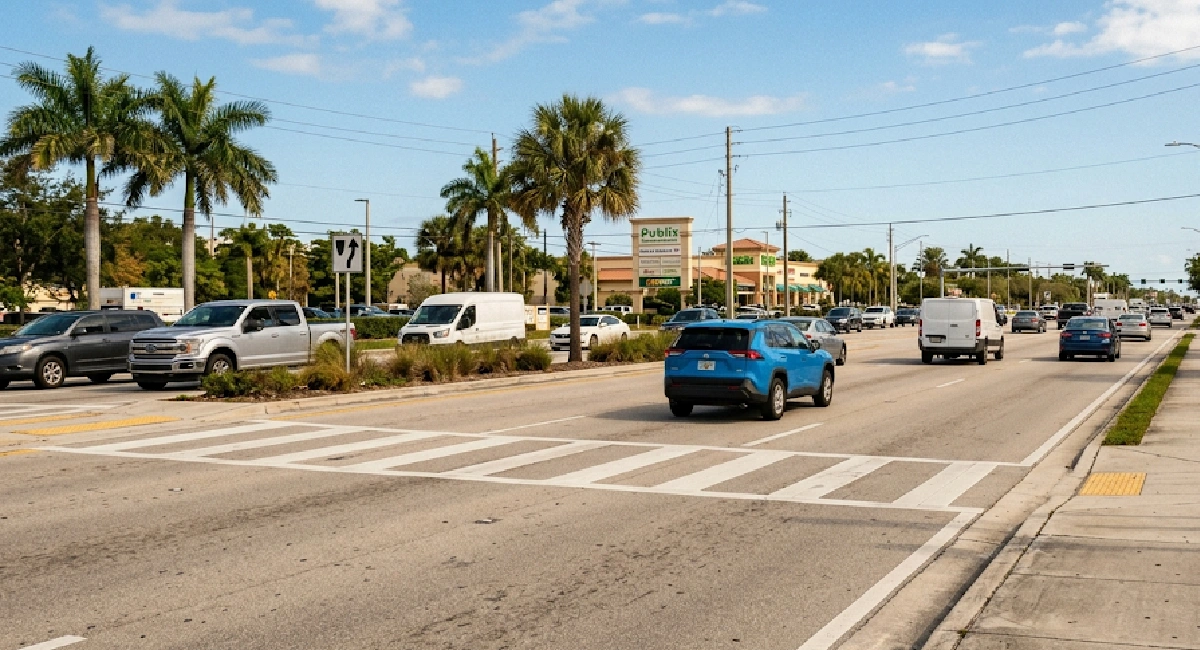
High-speed arterial roads like Beach Boulevard, Atlantic Boulevard, San Jose Boulevard, and Blanding Boulevard have long stretches without adequate crosswalk infrastructure, forcing pedestrians to cross in locations where drivers aren’t expecting them and stopping distances are inadequate. These roads account for a disproportionate share of serious pedestrian injuries in the area.
Intersections along US-1 through St. Johns County, particularly in the Nocatee and Ponte Vedra Beach areas where pedestrian traffic mixes with commuter vehicle volumes, produce regular pedestrian conflicts.
Downtown Jacksonville and the Riverside and San Marco neighborhoods see pedestrian accidents where vehicle speeds are lower but driver distraction and failure to yield are common causes.
School zones and residential areas throughout the Jacksonville metro see pedestrian accidents involving children, which carry specific legal considerations related to the standard of care expected of drivers in those locations.
When a Government Entity May Be Liable
Not every pedestrian accident is solely the driver’s fault. In some cases, the road design, inadequate pedestrian infrastructure, or poorly maintained crosswalks contributed to the crash. When a government entity’s failure to maintain safe pedestrian conditions causes or contributes to an accident, they may share liability.
Missing or faded crosswalk markings, absent pedestrian signals at dangerous intersections, inadequate lighting on high-pedestrian roads, and poorly designed sidewalks or crossing points are all conditions that can give rise to a claim against the City of Jacksonville, the Florida Department of Transportation, or a county government.
Claims against government entities in Florida involve specific procedural requirements. A pre-suit notice of claim must be filed within three years of the incident. Missing this deadline can bar the government liability claim even if the overall statute of limitations hasn’t expired. Government claims also involve damage caps under Florida’s sovereign immunity statute, which limit recovery against government defendants.
Michael McCabe’s civil engineering background and experience with structural and infrastructure analysis is directly applicable in cases involving road design and pedestrian infrastructure failures. Evaluating whether a road design created an unreasonably dangerous condition for pedestrians is exactly the kind of technical analysis he handles directly.
Hit and Run Pedestrian Accidents
Pedestrian hit and run accidents happen with troubling frequency in Florida. A driver who strikes a pedestrian and flees faces felony charges, but that doesn’t help the injured pedestrian who needs medical care and compensation.
If the driver is never identified, the injured pedestrian’s primary recovery source is their own uninsured motorist coverage, if they own a vehicle and carry UM coverage. The physical contact requirement that applies in some hit and run car accident cases is typically satisfied in pedestrian cases since the pedestrian was struck directly.
If the pedestrian doesn’t own a vehicle and has no UM coverage, the recovery options are more limited. This is one of the most difficult scenarios in pedestrian accident cases, and the importance of carrying UM coverage even when you rarely drive becomes clear.
Drunk Driving Pedestrian Accidents
A significant portion of serious and fatal pedestrian accidents involve drunk or impaired drivers, particularly at night and on weekends. When impairment contributed to the crash, the case for both compensatory and punitive damages strengthens considerably.
A driver who was well above the legal limit when they struck a pedestrian has demonstrated conscious disregard for the safety of others. Florida law allows punitive damages in those circumstances, which can significantly increase the total recovery beyond the standard damages calculation.
DUI convictions in pedestrian cases that also involve criminal charges become powerful evidence in the civil claim. The civil case can proceed without waiting for the criminal process, but a conviction substantially strengthens the plaintiff’s position.
Injuries Involving Elderly Pedestrians
Florida’s large elderly population is overrepresented in pedestrian accident statistics. Older pedestrians cross more slowly, may have reduced reaction time, and often sustain more severe injuries from the same impact force than younger adults.
Cases involving elderly victims require careful attention to pre-existing conditions. Insurers routinely argue that injuries attributed to the accident were actually pre-existing, particularly in cases involving older plaintiffs with documented health histories. Medical expert testimony establishing that the accident caused or significantly aggravated specific conditions is often the critical evidence in these cases.
The damages picture in cases involving elderly pedestrians also requires analysis of life expectancy, the impact of injuries on remaining quality of life, and future medical needs in the context of existing health conditions. These calculations are more complex than in younger adult cases and require experienced handling.
What to Do After a Pedestrian Accident
Call 911 immediately. Even if you feel capable of movement, stay at the scene until emergency responders arrive. A police report documenting the accident, the vehicle, and the driver is foundational to your claim.
If you’re physically able, photograph the scene. The vehicle, its position relative to the crosswalk or intersection, any skid marks, and your injuries. If there are witnesses, get their names and contact information before they leave.
Seek emergency medical care. Pedestrian accident injuries frequently involve internal trauma that isn’t immediately obvious. Same-day evaluation is essential both medically and for your claim. Florida’s 14-day PIP access window applies here as well.
Don’t give a recorded statement to the driver’s insurer. They will call quickly. Direct them to your attorney.
Contact an attorney before making any decisions about your claim. Pedestrian accident cases involving serious injuries have large damages at stake and are defended vigorously by insurers. The earlier an attorney is involved, the better the evidence picture that can be preserved.
Recovering What You’re Actually Owed
Pedestrian accident cases typically involve some of the most serious injuries in personal injury law. The damages available reflect that: full medical expenses past and future, lost wages and earning capacity, pain and suffering, permanent injury and disfigurement, and loss of enjoyment of life. When the driver’s conduct was egregious, punitive damages may apply.
Martino & McCabe handles pedestrian accident cases throughout Ponte Vedra Beach, Jacksonville, St. Johns County, Duval County, and Clay County. If you or a family member has been struck by a vehicle, the severity of these cases means getting experienced representation in place as early as possible.
Call (904) 999-4657 or reach out at consultation@martinomccabe.com for a free consultation.

Michael J. McCabe, is a partner and owner of Martino & McCabe and practices in the areas of personally injury, auto accidents, and premises liability. He is a licensed Professional Engineer and received his Bachelor of Science in Civil Engineering from Florida State University. He earned his Juris Doctor degree from Florida Coastal School of Law in 2005 while continuing to work as a Professional Engineer.