
October 13, 2026
Fault is the center of almost every disputed car accident claim in Florida. The other driver’s insurer isn’t going to hand over a fair settlement because you say the crash was their client’s fault. You have to prove it. And how well you prove it directly affects how much you recover.
Here’s how fault actually gets established in a Florida car accident case.
What Proving Fault Actually Means
In legal terms, proving fault in a car accident case means establishing negligence. That requires four elements: the other driver had a duty to operate their vehicle safely, they breached that duty, that breach caused the crash, and the crash caused your damages.
Every licensed driver in Florida has a duty to operate their vehicle with reasonable care. That’s the easy part. The fight is almost always over whether they breached that duty and whether that breach is what caused your injuries.
Florida’s modified comparative fault rule adds another layer. Since 2023, if you’re found more than 50% at fault for the crash, you recover nothing. Below that threshold, your recovery is reduced by your percentage of fault. This means the other side has a financial incentive to argue you share blame, even when the facts don’t support it. Proving fault clearly and completely is how you shut that argument down.
The Police Report
The police report is the first piece of evidence in most car accident cases, and it carries real weight.
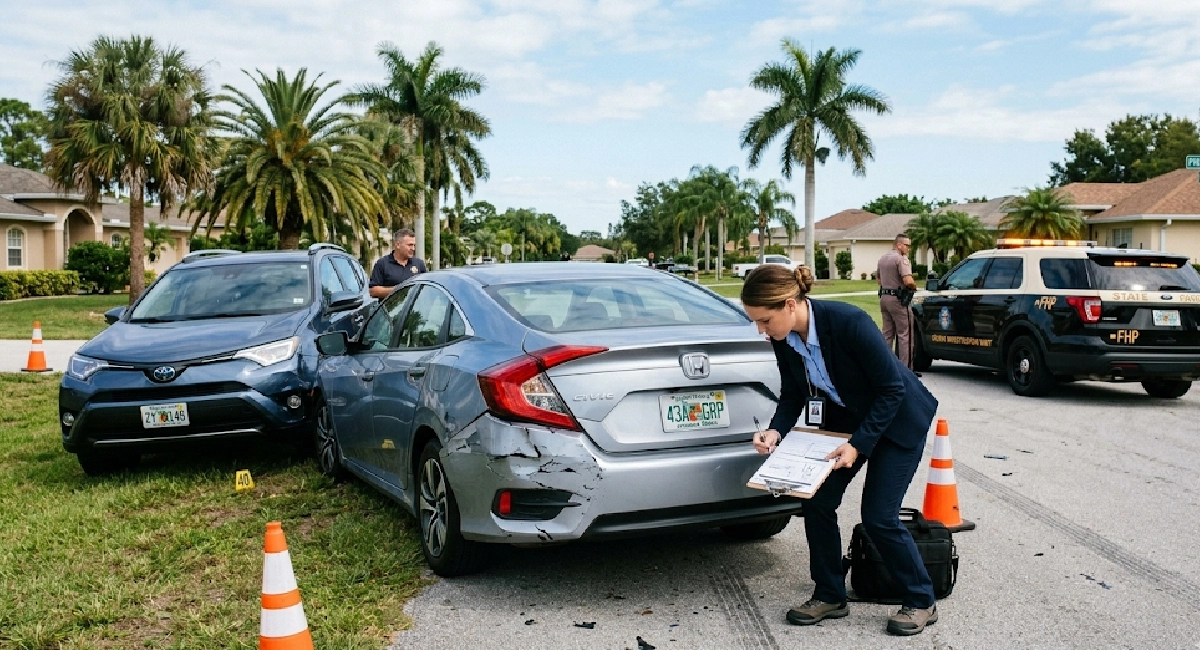
When an officer responds to the scene, they document the positions of the vehicles, road conditions, witness accounts, and any traffic violations observed. If the other driver was cited, that citation is noted. Officers sometimes include a preliminary determination of fault, though that finding isn’t binding on a court or an insurer.
What matters is that the report creates a contemporaneous record of what happened, documented by a neutral third party, before anyone has had time to revise their account. That record is harder to dispute than anything said days or weeks later.
Get a copy of the police report as soon as it’s available. In Florida, crash reports are typically available through the Florida Department of Highway Safety and Motor Vehicles within a few days of the accident. Review it for accuracy. If there are errors, an attorney can help you address them.
Physical Evidence From the Scene
The crash scene tells a story, and physical evidence preserves it before it disappears.
Skid marks show where a driver applied brakes and how hard. Vehicle positions at rest, before anyone moves them, show the direction and angle of impact. Damage patterns on both vehicles reveal the point of contact and the force involved. Debris fields indicate the location of impact relative to lane markings.
This evidence starts disappearing within hours. Skid marks fade. Vehicles get moved or repaired. Weather changes the scene. Photographs taken immediately after the crash capture what the scene actually looked like before any of that happens.
Video footage is increasingly available and often decisive. Traffic cameras, dashcams, nearby business surveillance systems, and doorbell cameras can all capture a crash or the moments leading up to it. That footage typically gets overwritten within days. Preserving it requires a preservation letter sent quickly to whoever controls the system.
An attorney who moves fast on evidence preservation has a significant advantage over one who waits.
Witness Testimony
Independent witnesses, people with no connection to either driver, carry substantial credibility. Their accounts of what they saw are difficult for the defense to dismiss as self-serving.
Witnesses at the scene should be identified before they leave. Names, phone numbers, and a brief account of what they saw. Even a witness who only saw the aftermath, the positions of the vehicles, who got out of which car, who seemed injured, can add useful context.
Witness memories fade and details shift over time. Statements taken close to the accident are more reliable than recollections gathered months later during discovery.
Medical Records and Injury Documentation
The connection between the crash and your injuries is a separate element of fault that has to be established. The defense will argue your injuries existed before the accident, were caused by something else, or aren’t as serious as you claim.
Medical records from treatment that begins immediately after the crash are the foundation of the causation argument. They document what injuries were present, when they were identified, and how they’ve progressed. A treating physician who can testify that your injuries are consistent with the mechanism of the crash and inconsistent with a pre-existing condition is a powerful witness.
Gaps in treatment create openings for the defense. Consistent care, documented thoroughly, closes those openings.
Expert Witnesses
In cases where liability is seriously disputed or the facts are technically complex, expert witnesses establish what the physical evidence actually means.
Accident reconstruction experts analyze vehicle damage, skid marks, impact angles, and vehicle speeds to reconstruct what happened. They can establish that the physics of the crash are consistent with your account and inconsistent with the other driver’s version.
Medical experts testify about injury causation, the nature and extent of your injuries, and what future treatment will look like. Engineering experts address road design defects, vehicle mechanical failures, and other technical questions that go beyond what a lay witness can explain.
Michael McCabe holds a civil engineering degree from Florida State and spent seven years in civil, aviation, and structural engineering before becoming an attorney. When a car accident case involves questions about road conditions, vehicle mechanics, structural failure, or accident dynamics, he evaluates those issues directly. That means the technical foundation of your case gets built by someone with genuine expertise, not assembled from hired consultants after the fact.
Cell Phone and Electronic Records
Distracted driving is a leading cause of car accidents, and electronic records can prove it.
Cell phone records subpoenaed during discovery show whether the other driver was on a call or texting at the time of the crash. Vehicle event data recorders, sometimes called black boxes, capture speed, braking, throttle position, and other data in the seconds before impact. Many modern vehicles have them.
These records require prompt action to preserve. A litigation hold letter sent early in the case puts the other side on notice that electronic evidence must be preserved. Waiting too long means data gets overwritten or destroyed.
Traffic Violations and Citations
If the other driver was cited at the scene, that citation is evidence of negligence. Running a red light, failure to yield, speeding, improper lane change, driving under the influence. These citations don’t automatically establish liability in a civil case, but they’re strong evidence that the driver breached their duty of care.
Even without a citation, traffic law violations can be established through witness testimony, physical evidence, and the driver’s own deposition testimony. A driver who admits they didn’t see you before the crash, or that they were changing lanes without checking their mirror, has made your case significantly easier.
The Other Driver’s Own Statements
What the other driver says matters. Statements made at the scene, to police, in recorded calls with their insurer, and in deposition testimony all become part of the evidentiary record.
Deposition testimony is particularly valuable. Under oath, with a court reporter present, the other driver has to answer questions about exactly what they were doing, where they were looking, and what they observed before the crash. Inconsistencies between their deposition testimony and what they told police, or what the physical evidence shows, go directly to credibility.
Preparing for and conducting an effective deposition of an adverse witness is a skill. Nicholas Martino’s Master of Laws in Trial Advocacy from Temple University Beasley School of Law, one of the top two trial programs in the country, is exactly the kind of training that matters here.
Putting It Together
Proving fault in a Florida car accident case isn’t a single piece of evidence. It’s a picture built from multiple sources: the police report, physical evidence, witnesses, medical records, expert analysis, electronic data, and the other driver’s own words. The strength of that picture determines how much leverage you have in settlement negotiations and how well-positioned you are if the case goes to trial.
Getting that picture built correctly requires moving fast, knowing what to look for, and having the technical and legal knowledge to present it effectively.
Talk to an Attorney Before the Evidence Disappears
Martino & McCabe handles car accident cases throughout Ponte Vedra Beach, Jacksonville, and St. Johns County. The earlier you bring an attorney in, the better the evidence picture gets preserved.
Call (904) 999-4657 or reach out at consultation@martinomccabe.com for a free consultation.
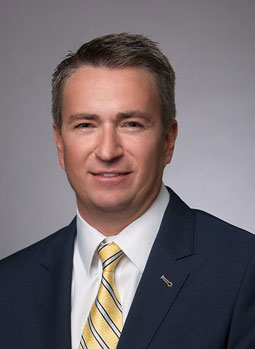
Michael J. McCabe, is a partner and owner of Martino & McCabe and practices in the areas of personally injury, auto accidents, and premises liability. He is a licensed Professional Engineer and received his Bachelor of Science in Civil Engineering from Florida State University. He earned his Juris Doctor degree from Florida Coastal School of Law in 2005 while continuing to work as a Professional Engineer.